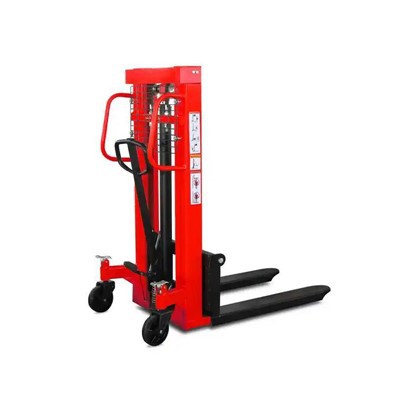
As a supplier of Aluminum Manual Stackers, I've had the privilege of witnessing firsthand the diverse applications and remarkable features of these essential warehouse tools. One of the most frequently asked questions from our customers revolves around the flexibility of the fork movement on an Aluminum Manual Stacker. In this blog post, I'll delve into this topic, exploring the various aspects that contribute to the fork's flexibility and why it matters in a real - world warehouse setting.


Understanding the Basics of Fork Movement
The fork movement on an Aluminum Manual Stacker is a critical feature that determines its usability and efficiency. At its core, the forks are the components that directly interact with the pallets or loads. They need to be able to move up and down, as well as adjust in width in some cases, to accommodate different types of loads.
The vertical movement of the forks is typically achieved through a hydraulic mechanism. When the operator pumps the handle, hydraulic pressure builds up, causing the forks to rise. Releasing the pressure valve allows the forks to lower. This simple yet effective system provides a reliable way to lift and stack loads. For example, our Hydraulic Forklift Manual Stacker Lifter is designed with a high - quality hydraulic pump that ensures smooth and stable vertical fork movement.
Vertical Flexibility
Vertical flexibility is crucial when it comes to stacking loads at different heights. In a warehouse, goods are often stored on multiple levels of racks. An Aluminum Manual Stacker with good vertical flexibility can reach various heights, allowing for efficient use of vertical space.
Our stackers are designed to offer a wide range of lifting heights. For instance, the 1500kg Manual Stacker can lift loads to a significant height, which is suitable for most standard warehouse racking systems. This vertical flexibility not only increases storage capacity but also reduces the need for additional equipment in some cases.
Moreover, the speed of vertical movement is also an important factor. Our stackers are engineered to provide a reasonable lifting and lowering speed. A fast - lifting speed can improve productivity, especially when dealing with a large number of loads. However, it's also important to ensure that the movement is stable to prevent damage to the load or the stacker itself.
Horizontal Flexibility (Width Adjustment)
In addition to vertical movement, some Aluminum Manual Stackers offer horizontal flexibility in the form of adjustable fork width. This feature is extremely useful when handling pallets of different sizes. Standard pallets come in various dimensions, and having the ability to adjust the fork width allows the stacker to handle a wider range of pallets without the need for multiple stackers.
Our Manual Stackers Pallet Lifter is equipped with an adjustable fork width mechanism. This allows the operator to quickly and easily adjust the distance between the forks to match the pallet size. Whether it's a small - sized pallet for light - duty loads or a large - sized pallet for heavy - duty items, the stacker can be adapted accordingly. This horizontal flexibility not only enhances the stacker's versatility but also reduces the overall cost of equipment for the warehouse.
Flexibility in Maneuvering
The flexibility of fork movement is also closely related to the stacker's overall maneuverability. In a busy warehouse environment, space is often limited, and the stacker needs to be able to navigate through narrow aisles and around obstacles.
The design of our Aluminum Manual Stackers takes this into account. The forks are positioned in a way that allows for easy turning and maneuvering. The stacker's wheels are designed for smooth movement, and the steering mechanism is responsive. This combination ensures that the stacker can be easily guided to the desired location, even in tight spaces. For example, when approaching a pallet in a narrow aisle, the operator can precisely position the forks to pick up the load without causing any damage to the surrounding goods.
Impact on Productivity
The flexibility of the fork movement has a direct impact on warehouse productivity. A stacker with good vertical and horizontal flexibility can handle a wider variety of loads and operate in different warehouse layouts. This means that fewer stackers may be required to cover the same amount of work, reducing equipment costs and maintenance efforts.
For example, if a warehouse has different types of pallets and needs to stack goods at various heights, an Aluminum Manual Stacker with flexible fork movement can perform multiple tasks without the need for constant equipment changes. This saves time and increases the overall efficiency of the warehouse operations.
Safety Considerations
While discussing the flexibility of fork movement, safety should always be a top priority. The design of our stackers includes several safety features to ensure that the flexible fork movement is carried out safely.
For vertical movement, there are safety valves in the hydraulic system to prevent over - lifting and sudden drops. The forks are also designed with a proper load - bearing capacity to ensure that they can safely handle the weight of the load. When it comes to horizontal flexibility, the adjustable fork width mechanism is designed to lock securely in place to prevent accidental width changes during operation.
Conclusion
In conclusion, the flexibility of the fork movement on an Aluminum Manual Stacker is a multi - faceted feature that encompasses vertical movement, horizontal width adjustment, and overall maneuverability. It plays a crucial role in enhancing warehouse productivity, increasing storage capacity, and ensuring the safe handling of loads.
As a supplier, we are committed to providing high - quality Aluminum Manual Stackers with excellent fork flexibility. Our products are designed to meet the diverse needs of modern warehouses, whether it's a small - scale operation or a large - scale distribution center.
If you're interested in learning more about our Aluminum Manual Stackers or have any specific requirements for your warehouse, we encourage you to contact us for a detailed discussion. Our team of experts is ready to assist you in finding the perfect stacker solution for your business.
References
- Industry standards for manual stackers
- Warehouse equipment design and safety guidelines