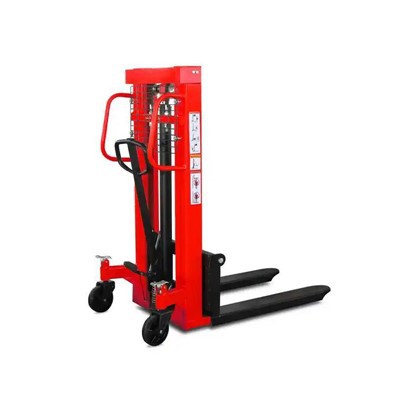
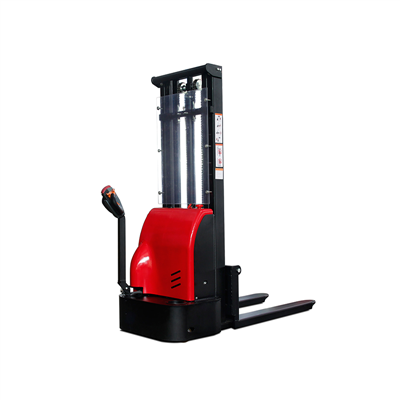
The turning radius of a hand manual stacker is a crucial parameter that significantly affects its maneuverability and practicality in various working environments. As a professional hand manual stacker supplier, I am well - versed in the importance of this specification and its implications for our customers.
Understanding the Concept of Turning Radius
The turning radius of a hand manual stacker refers to the minimum radius of the circle that the stacker needs to complete a full turn. It is typically measured from the center of the turning axis to the outermost point of the stacker during the turning process. A smaller turning radius means that the stacker can make sharper turns and operate more efficiently in confined spaces, such as narrow aisles in warehouses or small workshops.
Factors Influencing the Turning Radius
1. Wheel Design and Configuration
The design and arrangement of the wheels play a vital role in determining the turning radius. Hand manual stackers usually have a combination of swivel wheels and fixed wheels. Swivel wheels, which can rotate 360 degrees, allow for more flexible movement and smaller turning radii. For example, stackers with multiple swivel wheels at the front or rear can make tighter turns compared to those with just a few fixed - position wheels. The size and type of the wheels also matter. Smaller - diameter wheels can potentially reduce the turning radius as they require less space to pivot.
2. Fork Width and Length
The dimensions of the forks, including their width and length, can impact the turning radius. Longer forks may cause the stacker to have a larger turning radius because they extend further from the main body of the stacker. When turning, the long forks need more space to clear obstacles and complete the rotation. On the other hand, a wider fork base can also increase the turning radius, as the overall width of the stacker's footprint affects how easily it can turn in a confined area.
3. Overall Body Structure
The structural design of the stacker's body influences its turning ability. Compact and streamlined body designs tend to have smaller turning radii. Some stackers are engineered with a low - profile design and a centralized center of gravity, which makes them more stable and easier to turn. In contrast, stackers with bulky or extended body parts may have a larger turning radius and require more space to maneuver.
Importance of the Turning Radius in Different Applications
1. Warehouse Operations
In warehouses, where space is often at a premium, the turning radius of a hand manual stacker is of utmost importance. Warehouses are filled with racks, pallets, and stored goods, which create narrow aisles. A stacker with a small turning radius can easily navigate these aisles, allowing operators to move goods quickly and efficiently. This not only saves time but also increases the overall productivity of the warehouse. For instance, when using a Manual Stacker 4m, a small turning radius enables the operator to reach the desired storage locations without the need for extensive repositioning.
2. Retail Stores
Retail stores also rely on hand manual stackers for restocking shelves and moving inventory. The aisles in retail stores are usually narrower than those in warehouses, and they are often filled with display units and customers. A stacker with a tight turning radius can operate smoothly in these congested areas, minimizing the risk of collisions with displays or other objects. This ensures a safe and efficient working environment for store employees.
3. Small Workshops
In small workshops, space is limited, and the movement of materials and equipment needs to be carefully planned. Hand manual stackers with a small turning radius are ideal for these settings, as they can be easily maneuvered around tools, machinery, and workbenches. They allow workers to move raw materials and finished products within the workshop without causing disruptions to the workflow.
Measuring the Turning Radius
To measure the turning radius of a hand manual stacker accurately, a specific testing procedure is usually followed. The stacker is placed on a flat and open surface, free from any obstacles. The operator then turns the stacker in a complete circle at a constant speed, using the steering mechanism. The radius of the circle formed by the outermost point of the stacker during this turning process is measured using appropriate measuring tools, such as a tape measure or a laser rangefinder.


It's important to note that the turning radius may vary depending on whether the stacker is loaded or unloaded. A loaded stacker may have a slightly larger turning radius due to the additional weight and the change in the center of gravity. Therefore, it is recommended to test the turning radius in both loaded and unloaded conditions to get a comprehensive understanding of the stacker's maneuverability.
Our Hand Manual Stackers and Turning Radius Performance
As a leading Hand Manual Stacker supplier, we take great pride in the design and engineering of our stackers to ensure optimal turning radius performance. Our team of experienced engineers uses advanced design software and simulation tools to optimize the wheel configuration, fork dimensions, and body structure of our stackers.
We offer a wide range of Manual Stackers with different turning radii to meet the diverse needs of our customers. Whether you need a stacker for a large - scale warehouse or a small retail store, we have the right solution for you. Our stackers are built with high - quality materials and precision - made components, ensuring reliable and consistent performance.
When selecting a hand manual stacker, it is advisable to consider the specific working environment and the tasks it needs to perform. If you are working in a narrow - aisle warehouse, a stacker with a smaller turning radius would be more suitable. On the other hand, if you need to handle larger loads over longer distances, a stacker with a slightly larger turning radius may still offer the required stability and capacity.
Conclusion
In conclusion, the turning radius of a hand manual stacker is a critical factor that affects its usability and efficiency in various industrial and commercial settings. By understanding the factors that influence the turning radius and carefully selecting the right stacker for your needs, you can enhance productivity, reduce the risk of accidents, and optimize the use of your workspace.
If you are in the market for a hand manual stacker, we encourage you to contact us for more information. Our team of experts is ready to assist you in choosing the most suitable stacker based on your specific requirements. We are committed to providing high - quality products and excellent customer service to meet and exceed your expectations. Let us help you find the perfect hand manual stacker for your business!
References
- "Materials Handling Equipment Handbook", John Wiley & Sons.
- Industry whitepapers on the performance and design of manual stackers.