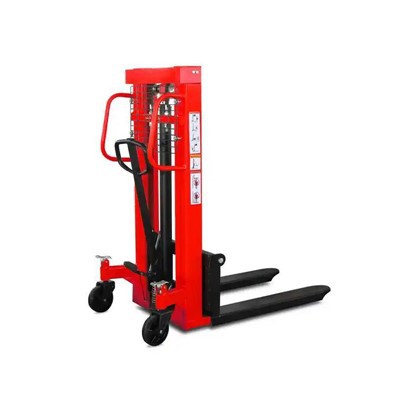
As a supplier of hand manual stackers, I often encounter various inquiries from customers about the diverse applications of our products. One question that has come up quite frequently is, "Can a hand manual stacker be used for stacking bookshelves?" In this blog post, I'll delve into this topic in detail, exploring the feasibility, advantages, limitations, and key considerations when using a hand manual stacker for bookshelf stacking.
Feasibility of Using a Hand Manual Stacker for Stacking Bookshelves
First and foremost, let's assess the feasibility of using a hand manual stacker for this task. A hand manual stacker is a versatile piece of equipment designed to lift and move heavy loads within a warehouse or storage facility. It typically consists of a hydraulic lifting mechanism, a pair of forks, and a set of wheels for easy maneuverability. When it comes to stacking bookshelves, the key factors to consider are the weight and size of the bookshelves, as well as the lifting capacity and reach of the stacker.
![8[Q3E0LX~HG{Y1$S]LHJHS8](/uploads/43572/2-ton-manual-stacker-hydraulica8c6f.png)

Most hand manual stackers have a lifting capacity ranging from 1 ton to 2 tons. This means that they can easily handle the weight of most standard bookshelves, which typically weigh between a few hundred pounds to a couple of thousand pounds, depending on their size and construction. Additionally, hand manual stackers are available in various fork lengths and lifting heights, allowing you to choose a model that is suitable for the specific dimensions of your bookshelves.
Advantages of Using a Hand Manual Stacker for Stacking Bookshelves
There are several advantages to using a hand manual stacker for stacking bookshelves. Firstly, it significantly reduces the physical effort required to lift and move heavy bookshelves. Instead of relying on manual labor, which can be strenuous and time-consuming, a hand manual stacker allows you to lift and position bookshelves with ease, minimizing the risk of injury to your employees.
Secondly, using a hand manual stacker improves the efficiency of the stacking process. With its hydraulic lifting mechanism, you can quickly and easily raise the bookshelves to the desired height, saving you valuable time and increasing productivity. This is especially beneficial if you have a large number of bookshelves to stack or if you need to complete the task within a tight deadline.
Another advantage of using a hand manual stacker is that it provides greater precision and control when stacking bookshelves. The forks of the stacker can be adjusted to fit the width of the bookshelves, ensuring a secure and stable lift. Additionally, the stacker's wheels allow you to move the bookshelves smoothly and accurately into position, reducing the risk of damage to the bookshelves or the surrounding environment.
Limitations of Using a Hand Manual Stacker for Stacking Bookshelves
While hand manual stackers offer many advantages for stacking bookshelves, there are also some limitations to consider. One of the main limitations is the lifting height. Most hand manual stackers have a maximum lifting height of around 3 to 5 meters, which may not be sufficient for stacking bookshelves in taller storage facilities or warehouses. If you need to stack bookshelves at a greater height, you may need to consider using a powered stacker or a forklift.
Another limitation is the maneuverability of the stacker. Hand manual stackers are typically designed for use in relatively small and confined spaces, such as warehouses or storage rooms. They may not be suitable for use in larger or more open areas, where a powered stacker or a forklift may be more appropriate. Additionally, the stacker's forks may not be able to reach certain areas or angles, which can make it difficult to stack bookshelves in tight spaces or against walls.
Key Considerations When Using a Hand Manual Stacker for Stacking Bookshelves
Before using a hand manual stacker for stacking bookshelves, there are several key considerations to keep in mind. Firstly, you need to ensure that the stacker is in good working condition and that all safety features are functioning properly. This includes checking the hydraulic system, the forks, the wheels, and the brakes. You should also inspect the bookshelves for any damage or defects before attempting to stack them.
Secondly, you need to choose the right model of hand manual stacker for the specific requirements of your bookshelf stacking task. This includes considering the weight and size of the bookshelves, the lifting height and reach required, and the available space in your storage facility. You may also want to consider additional features, such as adjustable forks, a tilt function, or a load backrest, to improve the efficiency and safety of the stacking process.
Thirdly, you need to follow all safety guidelines and procedures when using a hand manual stacker. This includes wearing appropriate personal protective equipment, such as safety shoes, gloves, and a hard hat, and ensuring that the stacker is operated by a trained and qualified operator. You should also be aware of the stacker's maximum load capacity and never exceed it.
Our Hand Manual Stacker Products
At our company, we offer a wide range of hand manual stackers that are suitable for various applications, including stacking bookshelves. Our Manual Stacker 1000kg has a lifting capacity of 1000kg and is ideal for handling smaller bookshelves. It features a compact design and easy-to-use hydraulic lifting mechanism, making it perfect for use in small storage facilities or warehouses.
If you need to handle heavier bookshelves, our 2 Ton Manual Stacker Hydraulic is a great option. With a lifting capacity of 2 tons, it can easily handle the weight of most standard bookshelves. It also has a higher lifting height and longer forks, allowing you to stack bookshelves at a greater height and in larger spaces.
For those who need a more versatile option, our 1 Ton Manual Stacker is a popular choice. It has a lifting capacity of 1 ton and can be used for a variety of tasks, including stacking bookshelves, pallets, and other heavy loads. It features adjustable forks and a tilt function, allowing you to customize the stacker to suit your specific needs.
Conclusion
In conclusion, a hand manual stacker can be a valuable tool for stacking bookshelves. It offers many advantages, such as reducing physical effort, improving efficiency, and providing greater precision and control. However, it also has some limitations, such as limited lifting height and maneuverability. Before using a hand manual stacker for stacking bookshelves, it is important to consider the specific requirements of your task and choose the right model of stacker.
If you are interested in purchasing a hand manual stacker for your bookshelf stacking needs, please don't hesitate to contact us. Our team of experts will be happy to assist you in choosing the right product and providing you with all the information you need. We look forward to hearing from you and helping you find the perfect solution for your stacking requirements.
References
- OSHA. (n.d.). Powered Industrial Trucks. Retrieved from https://www.osha.gov/pit
- Forklift Certification. (n.d.). Manual Stackers. Retrieved from https://www.forkliftcertification.com/manual-stackers
- Warehouse Equipment Guide. (n.d.). Manual Stackers. Retrieved from https://www.warehouseequipmentguide.com/manual-stackers